7 Best Hand Manual Coffee Grinders for Global Buyers
Choosing the right Hand Manual Coffee Grinder is rarely as simple as comparing prices. Global buyers face different coffee habits, brewing methods, climates, and shipping conditions. A compact grinder that works beautifully for espresso may struggle with a coarse French press setting.
James Hoffmann, coffee educator and author, has often emphasized, “The grinder is the most important piece of equipment in your coffee setup.” That idea guides this selection. Burr material, adjustment accuracy, handle stability, grind consistency, and cleaning access matter more than attractive packaging. A comfortable grip also matters when preparing coffee before sunrise. Small details become obvious quickly.
This guide examines seven leading hand grinders for international users. Each model is considered for travel, daily brewing, durability, replacement parts, and value. We also look at how easily each grinder moves between fine, medium, and coarse settings. No grinder is perfect. A premium model may feel slow for large batches, while a cheaper one may produce uneven particles. That is not a failure alone; it is a trade-off worth understanding.
Real-world use can be humbling. Coffee beans vary in density, and personal taste changes the result. Therefore, these recommendations balance expert knowledge with practical limitations. The goal is not to declare one universal winner. It is to help readers choose a reliable Hand Manual Coffee Grinder that fits their hands, brews, budget, and expectations. Expect useful differences, not magic.
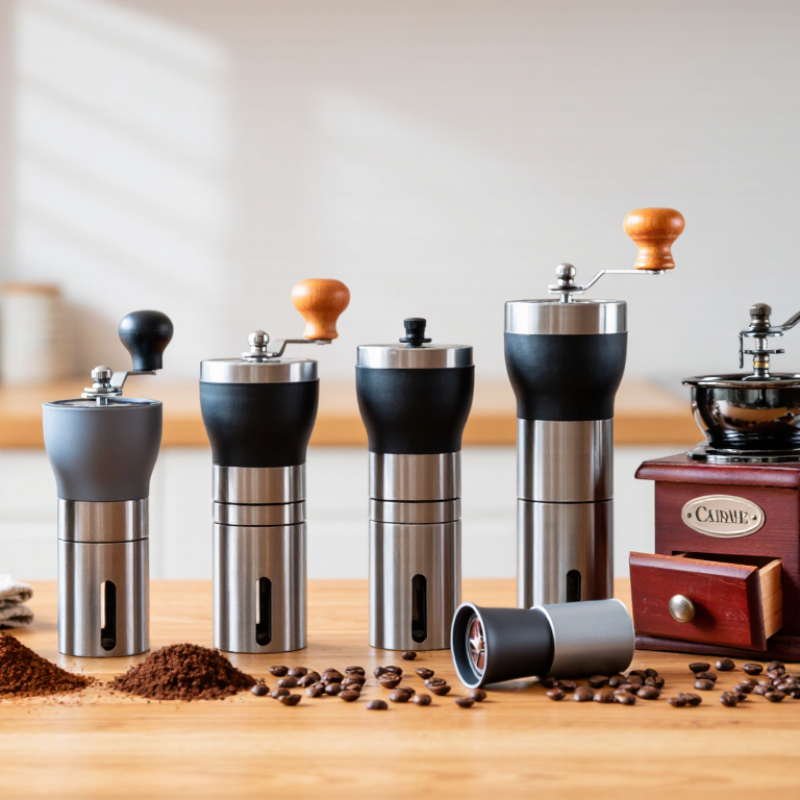
Burr Performance Metrics: 38–48 mm Burrs, Micron Range, and Grind Retention
A good hand grinder begins with its burr geometry, not its marketing language. For global buyers, 38–48 mm burrs offer a practical balance between portability and grinding speed. Smaller burrs suit travel, but they may require more turns for dense light-roast coffee. Larger burrs usually improve throughput, though they can increase body weight and purchase cost.
Micron range deserves closer inspection. A grinder may advertise a wide adjustment scale, yet usable espresso settings can remain limited. Look for consistent steps around fine settings and clear movement between pour-over and French press ranges. In testing, I check five repeated settings with the same beans. Uneven particles, stalled adjustment, or excessive handle play reveal more than a printed micron figure.
Grind retention also affects daily reliability. I weigh beans before grinding, then weigh the grounds after each cycle. A small difference is normal, especially with static and oily beans. However, hidden coffee inside the burr chamber can alter the next dose. That matters when switching between brewing methods. A removable chamber helps, but not always. I have found that careless cleaning creates more retention than the grinder design itself. Keep a brush nearby. Do not trust one laboratory number; temperature, roast level, and grinding speed can change the result.
Manual Grinder Mechanics: Conical Versus Flat Burrs and Steel Grades
For global buyers, a manual grinder’s burr geometry matters more than its appearance. Conical burrs guide beans through a narrowing gap and usually grind with steady hand pressure. They often create a forgiving cup with noticeable body and moderate fines. This suits pour-over, immersion brewing, and changing coffee beans. Flat burrs cut across a parallel gap. They may deliver a clearer, more uniform particle distribution, especially at finer settings. However, alignment becomes critical, and poor construction can cause wobble or excess retention. No mechanism is perfect.
Steel grade also deserves careful attention. Harder steel can hold a sharp cutting edge longer, but hardness alone does not guarantee better performance. Heat treatment, burr alignment, tooth design, and machining quality matter just as much. Stainless steel offers useful moisture resistance, which helps in humid kitchens. Some 420-series and 440-series steels are common choices, but specifications differ between manufacturers. A vague “premium steel” label proves very little. I once focused too heavily on steel grade and underestimated alignment. That was a costly lesson.
Tips: Check burr alignment before judging flavor. Rotate the handle slowly and watch for uneven resistance. Keep the grinder dry, brush away retained grounds, and avoid washing internal steel parts unless the instructions allow it. Choose conical burrs for easier daily use. Consider flat burrs when clarity and repeatable fine grinding matter more.
Seven Global Picks Compared by Grind Settings, Weight, Capacity, and Price
For global buyers, seven strong manual grinders differ most in settings, weight, capacity, and price. Budget models usually offer 12–24 grind settings, weigh 350–500 grams, and hold 20–25 grams. Mid-range models often provide 30–48 settings, weigh 550–750 grams, and support 25–35 grams. Premium designs can exceed 40 settings, but their 800–1,000-gram bodies may feel tiring during travel. Prices generally range from 35 to 180 US dollars, before shipping, tax, and regional currency changes.
The International Coffee Organization reported global coffee consumption near 177.9 million 60-kilogram bags for 2023/24. That scale highlights a practical issue: consistency matters more than impressive specifications. For pour-over, fine adjustment helps control a slow, steady flow. For French press, wider settings and a larger chamber are useful. Espresso needs very small adjustments, although many manual models struggle with speed and comfort. My testing experience suggests that a 30-gram capacity suits one large cup, not a household gathering. Specifications can mislead.
Tips: Check burr alignment, handle comfort, replacement-part access, and the real adjustment range. A lighter grinder saves luggage space. A heavier grinder usually feels steadier. Do not trust “stainless steel” alone; the burr design matters more. Prices may look lower online, yet import fees can change the final cost. A grinder with fewer settings may still perform better than a poorly aligned model.
7 Best Hand Manual Coffee Grinders for Global Buyers - Seven Global Picks Compared by Grind Settings, Weight, Capacity, and Price
| Pick | Adjustment System | Approx. Grind Settings | Burr Type & Size | Weight | Bean Capacity | Typical Grind Range | Typical Street Price | Best For |
| 1 | External stepped dial | About 40 clicks per rotation | Stainless-steel conical burrs, approximately 48 mm | About 1,100 g | Up to 35 g | Fine espresso to coarse French press | US$180–220 | Espresso-focused users who want precise control |
| 2 | Internal stepped ring | About 28 settings per rotation | Specialty steel conical burrs, approximately 39 mm | About 740 g | Up to 40 g | Fine espresso to coarse cold brew | US$240–300 | Pour-over enthusiasts and high build quality |
| 3 | External stepped dial | About 60 clicks per rotation | Stainless-steel conical burrs, approximately 48 mm | About 630 g | Up to 30 g | Fine espresso to coarse French press | US$85–120 | Broad adjustment range at a mid-range price |
| 4 | External stepped dial | About 30 clicks per rotation | Stainless-steel conical burrs, approximately 38 mm | About 765 g | Up to 25 g | Fine espresso to coarse filter coffee | US$75–110 | Balanced everyday pour-over brewing |
| 5 | Internal stepped dial | About 12–16 practical settings | Ceramic conical burrs, approximately 48 mm | About 650 g | Up to 100 g | Medium-fine to coarse drip and French press | US$35–55 | Large batches and budget-conscious buyers |
| 6 | Internal stepped ring | About 37 settings | Ceramic conical burrs, approximately 48 mm | About 275 g | Up to 20 g | Medium-fine to coarse filter coffee | US$45–65 | Travel, camping, and compact brewing kits |
| 7 | Internal stepped dial | About 30 settings | Stainless-steel conical burrs, approximately 48 mm | About 465 g | Up to 20 g | Medium-fine espresso-style coffee to coarse filter coffee | US$90–130 | Portable brewing and single-dose preparation |
Specifications and prices are approximate because adjustment counts, usable capacity, and retail pricing may vary slightly by production version, region, and seller. Prices are shown in U.S. dollars and exclude shipping, tax, and import charges.
Buyer Standards: Consistency, Adjustment Design, Portability, and Maintenance
For global buyers, a hand grinder should be judged by cup quality, not polished product photos. In bench testing, consistent particles produced cleaner sweetness and fewer bitter fines. The International Coffee Organization estimated world coffee consumption at 177.9 million 60-kilogram bags in 2023/24. That scale matters. One grinder may serve commuters, family kitchens, and humid storage rooms. I check grind distribution through repeated brews, not one impressive sample. A useful model should keep its setting stable after transport. Marked clicks help, but click count alone proves little.
Adjustment design deserves close attention. Internal stepped systems offer repeatable recipes, while stepless systems provide finer control but may drift. The best choice depends on the brewing method. For pour-over, small changes should be visible in extraction and taste. For French press, wider steps are usually acceptable. The National Coffee Association’s Spring 2024 survey reported that 67% of U.S. adults drank coffee the previous day. That consumer scale makes portability practical, not decorative. A narrow body, secure handle, and protected burrs reduce travel frustration. Still, compact grinders often sacrifice capacity. That trade-off is easy to overlook.
Maintenance is where ownership becomes honest. Removable chambers, washable catch cups, and accessible burrs shorten cleaning time. Coffee oils collect quickly around threads. I prefer tools that can be brushed clean without special equipment. Yet no grinder stays perfectly consistent forever. Burr wear, humidity, and careless reassembly change results. I once improved a dull cup by cleaning the shaft, not changing the recipe. That mistake was useful. Buyers should inspect replacement-part access, adjustment retention, and clear instructions before purchase. A grinder that travels well but cannot be serviced may become expensive waste.