What is UTP Cat 6 Cable and its Benefits?
UTP Cat 6 cable is a vital component in modern networking. It offers improved performance compared to previous categories. Many businesses and homes are now upgrading to UTP Cat 6. This cable supports higher bandwidth and is ideal for applications like streaming and gaming.
The benefits of using UTP Cat 6 are significant. It can handle data rates up to 10 Gbps over short distances. This feature is essential for minimizing latency in online activities. While the installation might seem straightforward, users must consider various factors.
However, not every environment is perfect for UTP Cat 6. Interference can still occur, potentially affecting performance. Users should also reflect on their specific needs before upgrading their networks. Overall, UTP Cat 6 cable stands out for its capabilities, yet it demands careful consideration in deployment.
What is UTP Cat 6 Cable?
UTP Cat 6 cable is a key component in modern networking. It is designed for high-speed data transmission. This cable supports frequencies up to 250 MHz. It allows for faster internet connectivity compared to its predecessors. With a maximum data rate of 1 Gbps over short distances, it meets the needs of many users.
This cable consists of four twisted pairs of copper wires. The twisting helps reduce electromagnetic interference. This is crucial in environments with multiple electronic devices. UTP Cat 6 cables are often used in homes and offices. They can handle streaming video and online gaming efficiently. However, installation can be tricky and might require professional help.
While UTP Cat 6 cables have many benefits, there are some downsides. The cable is less effective over longer distances. Beyond 100 meters, the performance drops significantly. Users should consider their specific needs before installation. In some cases, using a higher category cable may be necessary. The choice depends on the intended application and environment.
What is UTP Cat 6 Cable and its Benefits?
| Parameter |
Description |
| Cable Type |
Unshielded Twisted Pair (UTP) |
| Maximum Data Rate |
10 Gbps (Up to 55 meters) |
| Maximum Cable Length |
100 meters |
| Frequency |
Up to 250 MHz |
| Shielding |
None (UTP) |
| Key Benefits |
Cost-effective, High-speed data transfer, Easy installation |
| Use Cases |
Networking, Data Centers, Home and Office Use |
Key Features of UTP Cat 6 Cable
UTP Cat 6 Cable is a popular choice for high-speed networking. Its construction features four twisted pairs of copper wires. This design reduces crosstalk and interference, offering better performance than previous categories. The cable can support speeds up to 10 Gbps over short distances. It is ideal for connecting devices in homes and offices.
When considering UTP Cat 6, look for shielding options. Some cables come with added shielding to further minimize interference. This is crucial in busy environments with many electronic devices. Also, ensure the cable length suits your layout. Longer cables can lose signal quality.
Tip: Always test cables before installation. It prevents future headaches. Proper installation reduces the risk of damage.
Another notable feature of UTP Cat 6 is its backward compatibility. This means it can work with lower category cables. It makes transitioning to newer technology easier. However, over time, users may face limitations due to aging infrastructure. Regular assessments of your setup can help identify these issues early.
Advantages of Using UTP Cat 6 Cable
UTP Cat 6 cable is gaining popularity for its impressive performance. It supports up to 10 Gbps and frequencies of 250 MHz. This makes it suitable for high-speed internet and multimedia applications. Many businesses now rely on this cable to meet their networking demands. A report from the International Data Corporation (IDC) shows that network speed is critical for business productivity. Companies with faster networks can see a productivity increase of up to 30%.
One of the major advantages of UTP Cat 6 cable is its reduced crosstalk. Improved shielding minimizes interference. This allows for clear signal transmission, essential in crowded environments. According to research by the Telecommunications Industry Association (TIA), less interference leads to higher data integrity and reliability. Many users notice performance improvements when switching from older cables. It is also worth noting that this cable is cost-effective, offering performance similar to Cat 6a at a lower price.
However, not every installation benefits equally. Users must ensure proper installation to fully harness the advantages. Poor termination can lead to potential speed losses. Moreover, Cat 6 may not always be necessary for basic applications. Sometimes, businesses overestimate their needs. Balancing cost and performance is essential for making the right choice.
Comparison with Other Ethernet Cables
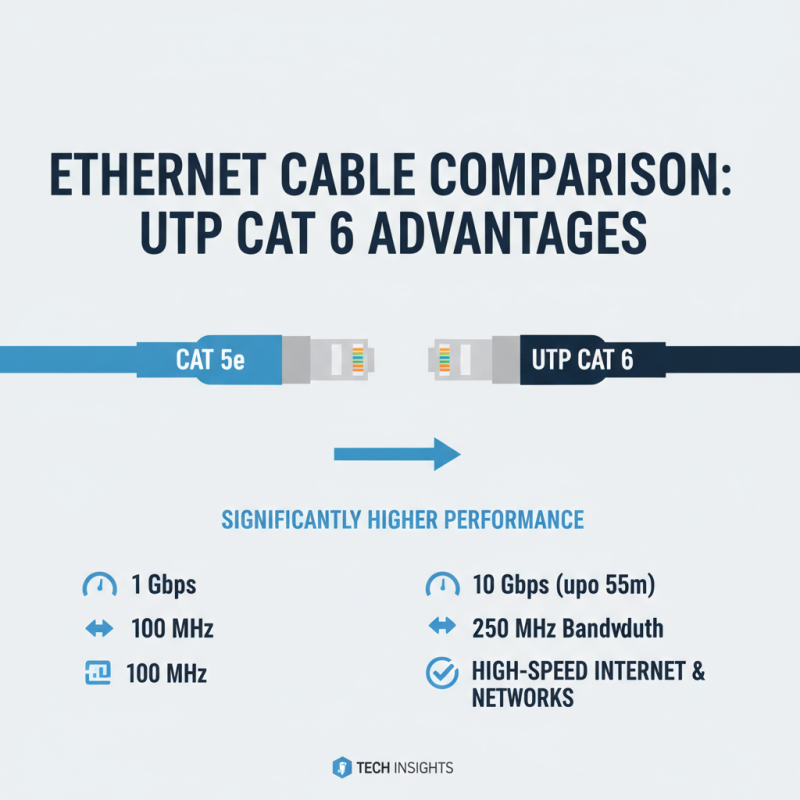
When comparing UTP Cat 6 cables to other Ethernet cables, it’s clear they offer several advantages. UTP Cat 6 cables can support data rates up to 10 Gbps at distances of up to 55 meters. This performance is significantly higher than Cat 5e cables, which typically support 1 Gbps. According to industry reports, UTP Cat 6 can handle a bandwidth of up to 250 MHz, making it suitable for high-speed internet and network applications.
However, there are downsides. While UTP Cat 6 provides better performance, it is more sensitive to interference than its predecessors. The cables can suffer from crosstalk in environments with heavy electrical interference. Additionally, for longer distances, users may not achieve the maximum speed. A recent study indicated that performance drops significantly beyond the recommended distances, which may not suit all setups.
In contrast, Cat 5e cables are more cost-effective, making them a popular choice for basic networking needs. They are easier to install in both residential and commercial spaces. Yet, as advances in technology continue, UTP Cat 6 cables may prove more future-proof. Many networks will eventually need higher speeds and better reliability, pushing users to upgrade their systems. Considering these factors is essential for making a well-informed decision.
Common Applications of UTP Cat 6 Cable
UTP Cat 6 cable serves various crucial roles in modern networking.
Primarily, it supports high-speed data transmission up to 10 Gbps over short distances.
According to a recent industry report by the Ethernet Alliance, businesses increasingly rely on
Cat 6 for reliable connections in office environments and data centers. It operates at frequencies up to 250 MHz,
allowing it to handle internet applications efficiently, particularly for video conferencing and cloud computing.
In residential settings, UTP Cat 6 is also becoming popular. Home automation systems and smart devices benefit from its
capacity to deliver stable connections. An estimated 78%
of home networks utilize Cat 6 cables, as highlighted by a report from the Telecommunications Industry Association.
This adoption reflects a shift toward high-performance network setups, essential for streaming and gaming experiences.
However, challenges exist. Users must consider the cable length, as distances over 55 meters
can compromise performance. Additionally, not all devices support the full capabilities of Cat 6, which may lead to underperformance.
Regular maintenance of cable connections and proper installation practices can mitigate potential issues. Understanding these nuances
helps users maximize their networking efficiency.