
A Corrugated Box Feeder Machine moves flat, folded, or stacked corrugated blanks into packaging equipment at a controlled speed. It supports printing, folding, gluing, die-cutting, and case-forming lines. In a typical plant, the machine separates blanks from a stack, aligns their edges, and feeds each sheet into the next station. A stable feed reduces jams, skewed cartons, and unnecessary operator intervention.
Market pressure makes this equipment increasingly relevant. Smithers’ The Future of Global Corrugated Packaging to 2029 reports continued growth in corrugated packaging demand, driven by e-commerce, food delivery, and retail distribution. FEFCO industry statistics also show the importance of corrugated packaging across European manufacturing and logistics networks. Meanwhile, PMMI reports that packaging companies continue investing in automation, labor efficiency, and flexible machinery. These findings explain why manufacturers are examining feeder performance rather than viewing it as a minor accessory.
Speed matters. But speed alone is not enough. A reliable Corrugated Box Feeder Machine must handle different board grades, flute profiles, sheet sizes, and stack conditions. Operators often notice the real difference during changeovers, when poor adjustment can create waste within minutes. Sensors, vacuum systems, servo drives, and adjustable guides can improve consistency. However, no machine removes every production problem. Board moisture, warped blanks, dust, and uneven stacking still require practical judgment. The terminology is not perfectly standardized across suppliers, so buyers should compare feed accuracy, range, maintenance access, and verified line performance. This guide explains how the machine works, where it fits, and which specifications deserve closer inspection.
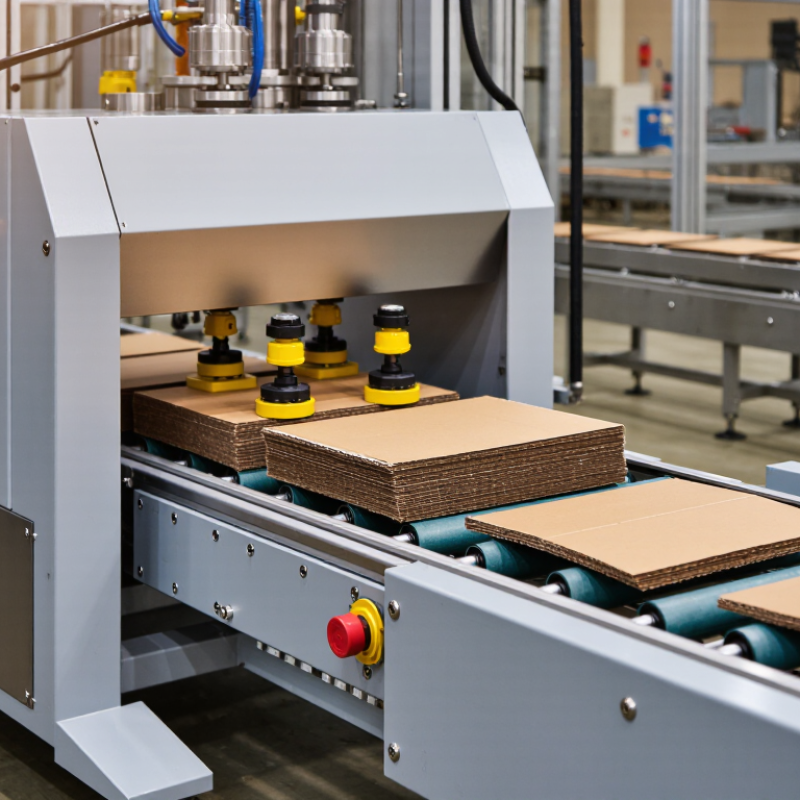
A corrugated box feeder machine separates, aligns, and transfers flat carton blanks into a production line. It usually works before printing, folding, gluing, or die-cutting equipment. Vacuum belts, suction heads, side guides, and sensors control each sheet’s movement. The goal is simple: one blank, at the correct speed, in the correct position.
This equipment matters because corrugated production is expanding.
FEFCO’s European Corrugated Statistics for 2023 reported approximately 48 billion square metres of corrugated board production. Smithers’ market outlook, The Future of Corrugated Packaging to 2029, estimated global corrugated packaging value at about 205 billion US dollars in 2024, with further growth expected by 2029. Higher volumes make stable feeding more valuable, especially when operators face mixed sizes and short production runs.
In practice, technicians should check feeder performance under real conditions. Warped blanks, dusty surfaces, weak fluting, and uneven stacking can cause double-feeds or jams. Small errors become expensive at high speed.
A practical evaluation should measure sheets per minute, misfeed frequency, setup time, and changeover consistency. It should also inspect vacuum pressure and guide adjustment.
Automation helps, but it is not perfect. A feeder may run smoothly during testing and struggle with recycled board later. That uncomfortable gap deserves attention. Each material grade needs its own settings, maintenance routine, and operator training.
A corrugated box feeder machine separates flat box blanks and delivers them into a production line. It commonly feeds folder-gluers, printers, and forming equipment. The machine must maintain steady spacing, even when cartons vary in size or thickness.
Operators place stacked blanks into the loading area. Adjustable guides hold the pile square and prevent side movement. A pickup mechanism lifts the lowest blank, usually with suction cups, belts, or friction rollers. The blank then moves forward through a controlled feeding path.
Sensors detect the leading edge and confirm each sheet’s position. Rollers adjust pressure so the board moves without crushing its flutes. Timing controls release each blank at a precise interval. The next machine receives a clean, consistent stream.
Small details matter. A slightly warped blank can cause a double feed. Excessive roller pressure may leave marks. Low pressure can create slipping. Moisture also changes board stiffness during a long shift. Experienced operators check the first several cartons by hand and adjust guides gradually.
Not perfectly automatic.
A reliable setup combines machine settings with practical observation. Feed speed, vacuum strength, and roller alignment often need minor correction. The best results come from matching these settings to the board grade, blank design, and line speed. In production, a quiet feeder is not always a perfect feeder; occasional checks reveal problems before they become expensive.
A corrugated box feeder machine separates flat blanks and delivers them to the next converting station. Its performance depends on several connected components, not one powerful motor. Smithers’ market analysis valued global corrugated packaging at approximately USD 205.6 billion in 2023. That scale increases pressure for stable, measurable feeding.
The magazine or hopper stores stacked blanks. Adjustable side guides keep the stack square, although poor adjustment still causes skewed cartons. A vacuum head or friction pickup separates each blank from the bottom or top of the stack. Belts then transfer it at a controlled speed. Sensors detect double feeds, missing blanks, and jams. Small details matter here. Dust can weaken suction.
Servo motors, gearboxes, and timing belts control movement between stations. A PLC coordinates these actions, while the HMI displays speed, alarms, and setup values. Safety guarding and interlocks protect operators around moving belts and pinch points. PMMI’s 2023 report, Automation in Packaging, identifies labor availability and production consistency as major drivers for packaging automation. Yet automation is not self-correcting. Operators still need to inspect belt wear, sensor alignment, and blank quality. A feeder may run quickly, but unstable board moisture can defeat precise settings.
What Is a Corrugated Box Feeder Machine?
Common Applications in Packaging Production
A corrugated box feeder machine moves flat, folded cartons into packaging lines at a controlled speed. It uses belts, rollers, guides, and sensors to separate blanks accurately. In production, this equipment supports case packing, carton forming, labeling, printing, and filling operations. It reduces manual handling, especially when workers must feed hundreds of boxes per hour. A stable feeder also protects carton edges from crushing and helps maintain consistent spacing between blanks.
Its applications vary across food, beverage, household goods, electronics, and general retail packaging. A packaging line may use the feeder before an automatic carton erector. Another setup sends cartons toward a gluing, coding, or sealing station. In my experience, feeder performance depends heavily on board thickness, moisture, folding quality, and stack alignment. Small differences can cause double feeding or sudden stoppages. That detail is easy to overlook.
Tips: Match the feeder settings to carton size and flute structure. Keep the stack square, dry, and free from damaged blanks. Check sensors and belts during each shift. Test several cartons before full production begins. Do not trust speed alone. A faster line can create more waste when alignment is poor. Operators should record jams, misfeeds, and adjustments, then review the pattern weekly. This practical feedback often reveals problems that routine inspections miss.
| Data Dimension | Typical Information | Practical Application |
|---|---|---|
| Machine Definition | An automated unit that separates, aligns, and continuously feeds flat corrugated blanks into the next packaging process. | Creates a stable and continuous supply of carton blanks for printing, die-cutting, folding, gluing, or stitching equipment. |
| Primary Input | Flat, pre-cut or creased corrugated sheets and box blanks, usually stacked on a pallet or loading platform. | Suitable for feeding blanks into folder-gluers, flexographic printers, rotary die-cutters, and box stitching lines. |
| Common Board Types | Single-wall boards such as E-, B-, and C-flute, plus selected double-wall combinations such as BC-flute. | Supports lightweight retail cartons, standard shipping boxes, and heavier-duty protective packaging. |
| Feeding Method | Vacuum belts, friction rollers, suction heads, or a combination of belt and roller conveying systems. | Maintains controlled blank separation and reduces double-sheet feeding during continuous production. |
| Typical Speed Range | Approximately 60–250 sheets or blanks per minute, depending on blank size, board grade, machine design, and line configuration. | Helps packaging lines maintain a consistent production rate while minimizing manual loading and interruptions. |
| Box Formats | Regular slotted cartons, half-slotted cartons, die-cut boxes, mailer boxes, trays, partitions, and selected specialty cartons. | Used for shipping cases, e-commerce packaging, food cartons, beverage packaging, and retail display packaging. |
| Printing Line Application | Feeds flat blanks into flexographic printing and printing-slotting equipment. | Improves sheet spacing and registration consistency before ink is applied or slots are cut. |
| Die-Cutting Application | Transfers sheets or blanks into rotary or flatbed die-cutting equipment. | Supports accurate positioning for handles, windows, locking tabs, ventilation holes, and custom contours. |
| Folder-Gluer Application | Feeds printed and creased blanks into a folding and adhesive application line. | Promotes smooth folding, glue placement, and carton alignment during high-volume box production. |
| Main Productivity Benefits | Continuous feeding, reduced manual handling, improved line utilization, and more consistent sheet spacing. | Helps reduce production stoppages and supports more predictable output in automated packaging operations. |
| Quality Control Function | May include sensors for sheet presence, double-sheet detection, skew monitoring, and jam detection. | Limits misfeeds and helps prevent incorrectly positioned blanks from entering downstream equipment. |
| Best-Fit Production Environment | Medium- to high-volume corrugated packaging plants, contract packers, and integrated carton converting lines. | Provides the greatest value where repeated box formats and stable production volumes justify automation. |
| Important Selection Factors | Blank dimensions, board thickness, flute profile, surface condition, required speed, stack height, and downstream machine compatibility. | Ensures reliable feeding across the intended range of carton sizes and materials. |
| Operational Considerations | Correct belt pressure, clean vacuum paths, accurate guides, suitable sheet stacking, and routine sensor maintenance are essential. | Proper setup helps reduce slippage, skewed blanks, double feeds, dust-related faults, and unnecessary downtime. |
Note: Performance ranges are typical industry references. Actual capacity depends on the machine configuration, carton dimensions, board grade, blank condition, and the requirements of the connected production line.
What Is a Corrugated Box Feeder Machine?
A corrugated box feeder machine separates, aligns, and delivers flat cartons into a packaging line. It replaces inconsistent manual feeding with controlled, repeatable movement. Operators typically adjust guides, suction, belts, or rollers for different board sizes. The correct setup reduces skewed blanks, feeding gaps, and unnecessary stoppages.
Key Factors for Choosing the Right Box Feeder Machine
Start with your carton specifications. Measure blank length, width, thickness, flute type, and printed surface condition. A feeder designed for thin board may struggle with rigid, double-wall cartons. Check the machine’s minimum and maximum feeding range. Measure twice.
Production speed matters, but maximum speed can be misleading. Ask for stable operating speed with your actual carton samples. A practical test should examine alignment, dust buildup, changeover time, and jam recovery. Faster is not always better. A small misalignment can damage folding accuracy downstream.
Consider adjustment access and operator training. Tool-free guides can shorten changeovers, while clear markings improve repeatability. Inspect belt materials, sensor protection, guarding, and emergency-stop access before purchase. Maintenance records and spare-part availability also support dependable operation. In real production environments, dust and warped blanks often expose weaknesses that specifications hide. Leave room for improvement; the first configuration may not be ideal. Choose equipment that can be tested, adjusted, and serviced without disrupting the entire line.
Board caliper is a key factor when choosing a corrugated box feeder. Thicker boards generally require stronger feed rollers, wider clearance adjustment, and higher feeding force. The values shown are typical nominal flute thicknesses; actual caliper varies by paper grade, liner combination, and manufacturing conditions.