
What Are the Best Cat 6 Network Cable Types in 2026?
Choosing the best cat 6 network cable in 2026 means matching its construction to the actual installation, not simply buying the thickest jacket. Cisco’s Annual Internet Report (2018–2023) forecast 29.3 billion networked devices and connections by 2023, up from 18.4 billion in 2018. That forecast is not a measurement of 2026 demand, but it reflects the steady growth in connected devices that makes dependable wired links valuable. At home, that may mean a router in the hallway and a work computer two rooms away. In an office, it could mean dozens of ports running through a cable tray.
The standards matter. TIA Category 6 specifications define performance up to 250 MHz, while IEEE 802.3ab supports Gigabit Ethernet over suitable twisted-pair cabling for channels up to 100 meters. Cat 6 can also carry 10-Gigabit Ethernet over shorter distances, commonly up to 55 meters, depending on installation conditions and interference. Details matter. Solid copper cable suits permanent in-wall runs; stranded conductors bend more easily in patch cords. Shielded options may help where electrical interference is a concern, but they require appropriate grounding and compatible components. Not all do. CCA cable, despite its lower price, is not equivalent to solid copper and may fail to meet expected performance. This guide compares unshielded and shielded, solid and stranded, and indoor and outdoor Cat 6 cable types. One caveat: “best” depends on distance, environment, and device requirements, so a popular choice is not automatically the right one.
How Cat 6 Cable Design Affects Speed, Distance, and Reliability
Cat 6 cable is rated to 250 MHz, but that figure describes bandwidth, not a guaranteed internet speed. ANSI/TIA-568.2-D sets performance requirements for balanced twisted-pair cabling, while actual throughput also depends on equipment, installation, and cable length. For everyday 1 Gigabit Ethernet, a compliant channel can reach 100 meters. A tidy cable on a desk is not the whole story.
The distance picture changes at 10 Gigabits per second. TIA’s TSB-155-A guidance evaluates installed Cat 6 cabling for 10GBASE-T over distances up to 55 meters, depending on alien crosstalk and other conditions. That interference can come from neighboring cables bundled tightly together. IEEE 802.3an specifies 10GBASE-T; Cat 6A is designed to support it across a 100-meter channel. Leave room for uncertainty: older Cat 6 runs may need testing before faster links are trusted.
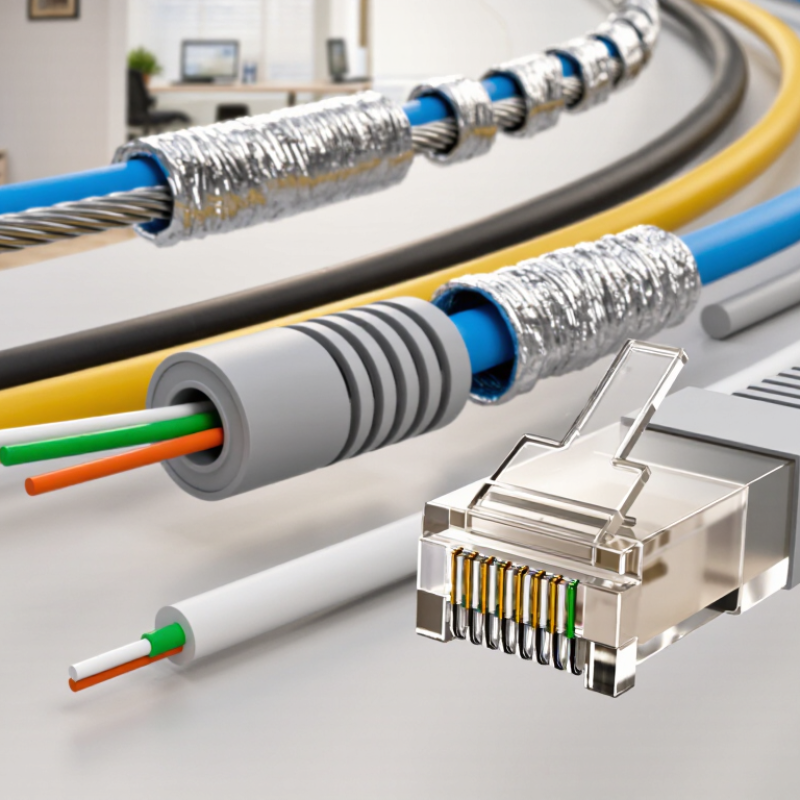
Cable construction affects those results. A solid-conductor cable suits fixed in-wall runs; stranded cable bends more easily for short patch connections. Twists and internal separators help limit interference, while shielding can help in electrically noisy spaces—but only when properly installed and grounded. A badly handled shield can disappoint. For a home run behind a desk, neat routing and sound terminations may matter more than buying a thicker cable.
What Are the Best Cat 6 Network Cable Types in 2026? — How Cat 6 Cable Design Affects Speed, Distance, and Reliability
| Cat 6 Design Type | Typical Construction | Best Suited For | Speed and Distance | Reliability Considerations |
|---|---|---|---|---|
| Unshielded twisted pair (UTP), solid conductor | Four twisted pairs of solid copper conductors, typically installed as permanent building cabling. | In-wall runs, offices, homes, and structured cabling between patch panels and outlets. | Supports 1 Gbps Ethernet up to 100 m. 10 Gbps may be supported over shorter Cat 6 channels, commonly up to 55 m depending on installation conditions and alien crosstalk. | Good general-purpose choice when routed away from major sources of electrical interference and installed within bend-radius and termination guidelines. |
| UTP, stranded conductor | Four twisted pairs made from multiple fine copper strands; more flexible than solid-conductor cable. | Short patch leads connecting equipment, patch panels, and wall outlets. | Cat 6 channel limits still apply; patch leads contribute to the total channel length. A complete channel is generally limited to 100 m for 1 Gbps. | Flexible and resistant to repeated bending, but generally has higher signal loss than solid cable over the same length. Not the usual choice for long permanent runs. |
| Shielded twisted pair (F/UTP or S/FTP) | Foil or braided shielding around the cable, individual pairs, or both; exact construction varies by cable design. | Routes near electrical equipment or in environments with substantial electromagnetic interference, when the installation supports proper bonding. | Shielding does not increase the Cat 6 bandwidth rating or standard Ethernet distance limits. Cat 6 is rated to 250 MHz. | Can help reduce interference when correctly installed. Shielding must be bonded and terminated according to the cabling system design; improper installation can undermine its benefit. |
| Riser-rated cable (CMR) | Cable jacket designed for use in vertical riser spaces between floors, subject to local building and fire codes. | Approved in-building pathways that connect floors and do not require plenum-rated cable. | Electrical performance depends on its Cat 6 construction, not its riser rating. Typical Cat 6 distance limits remain applicable. | The jacket rating addresses fire and smoke requirements, not network speed. Confirm local code requirements before installation. |
| Plenum-rated cable (CMP) | Jacket materials designed to meet stricter flame and smoke requirements for qualifying air-handling spaces. | Plenum spaces where required by applicable building codes. | Plenum rating does not raise bandwidth or extend Ethernet distance; performance is determined by the cable’s Cat 6 electrical specifications. | Choose when required by code. Plenum-rated cable is often more costly and may be less flexible than comparable non-plenum cable. |
| Outdoor or direct-burial Cat 6 | Jacket and, where specified, moisture protection designed for outdoor exposure or direct burial. | Outdoor building-to-building runs or underground routes, using the cable type and pathway permitted for the site. | Cat 6 performance limits are unchanged. Long outdoor copper runs also require consideration of lightning exposure, grounding, and Ethernet distance limits. | Use a cable specifically rated for the intended exposure. Conduit, drainage, surge protection, and local electrical codes may also be important. |
| Cat 6 with a pair separator (spline) | A nonconductive separator helps maintain spacing between twisted pairs; some designs also use other crosstalk-control measures. | Installations where consistent pair geometry and crosstalk control are priorities. | Cat 6 remains a 250 MHz category. A separator does not, by itself, guarantee 10 Gbps at 100 m. | Can support crosstalk control, but cable quality, termination, routing, and the complete channel design remain critical. |
| Cat 6 channel with Power over Ethernet (PoE) | Cat 6 cabling carries Ethernet data and DC power to compatible devices; conductor size, cable length, temperature, and installation density matter. | Wireless access points, cameras, phones, and other compatible powered network devices. | Data-rate and distance limits remain determined by the Ethernet standard and channel. Available power can be affected by cable resistance and heat buildup. | Use compliant copper cabling and compatible equipment. For high-power PoE or dense cable bundles, follow applicable installation guidance and verify temperature limits. |
Related Posts
-

How to Choose Cat 6 UTP Cable for Global Sourcing?
-
What Is the Best Cat 6 Bulk Cable in 2026?
-
2026 Best UTP Cat 6 Cable for Global Buyers
-
How to Choose the Right Network Patch Cable for Your Needs?
-
5 Best LC Patch Panels for Optimal Network Performance in 2023
-

Top 10 Enterprise Networking Solutions for Businesses Today?