
China Top Fiber Optic Patch Cord Manufacturers?
China has become a major manufacturing base for fiber optic patch cord products. Its suppliers serve data centers, telecom networks, FTTH projects, and industrial systems worldwide. However, “top” does not always mean the largest factory. It should mean consistent quality, verified testing, stable delivery, and useful technical support.
Dr. Charles K. Kao, widely recognized as the father of fiber-optic communications, said, “The optical fibre is a medium of transmission of information from one place to another.” His statement remains practical today. A well-made fiber optic patch cord carries light through a polished connector, often across crowded racks and narrow cable pathways. Small defects can create higher insertion loss, poor return loss, or unstable links. Details matter.
This guide examines leading Chinese manufacturers through measurable and practical criteria. These include connector polishing, fiber compatibility, bend-radius design, test reports, packaging, and production traceability. Reliable manufacturers should provide test results for every batch, not only attractive product photographs. ISO certification can support credibility, but it cannot replace independent inspection or field experience. That distinction is often missed.
Real projects also reveal uncomfortable differences. Some suppliers respond quickly before receiving an order, then become slower during delivery problems. Others offer low prices but limited documentation. No supplier is perfect. Buyers should compare samples, testing methods, warranty terms, and communication records before choosing a long-term partner. The strongest manufacturers combine engineering knowledge with repeatable production. They also admit limitations. That honesty can be more valuable than impressive marketing.
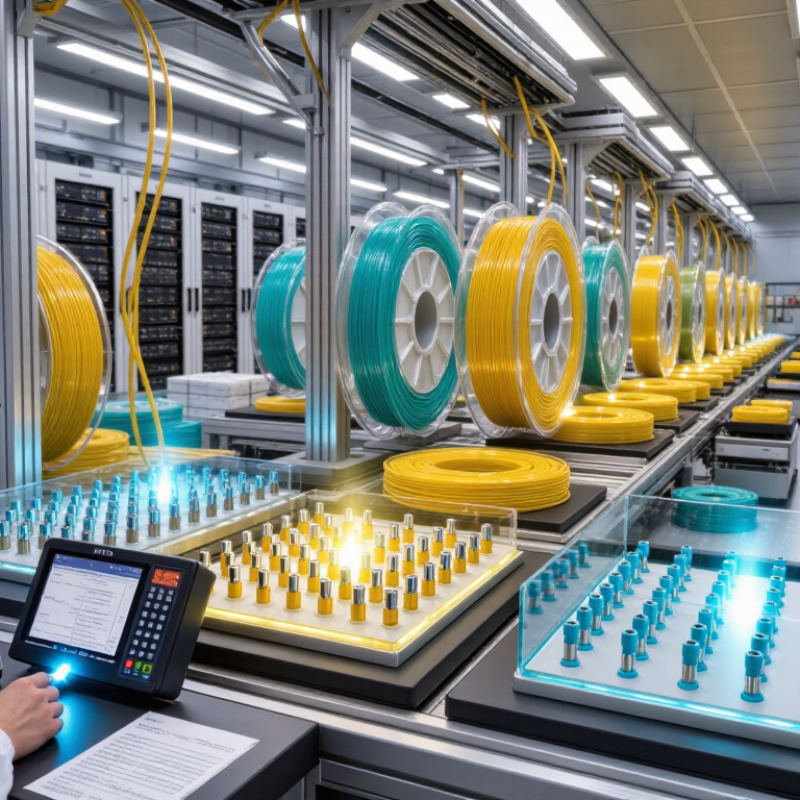
Definition and Role of Fiber Optic Patch Cords
China Top Fiber Optic Patch Cord Manufacturers?
Definition and Role of Fiber Optic Patch Cords
A fiber optic patch cord is a short cable with connectors at both ends. It links optical equipment to network outlets, patch panels, or other cables. Inside, a glass fiber carries data as pulses of light. The cord’s job is simple, but its quality affects signal loss, stability, and maintenance. ITU reported that 5.4 billion people used the internet in 2023, about 67% of the world’s population. That growing connectivity depends on reliable network links, including small connections inside equipment rooms.
In a server room, a technician may connect a switch to a panel using a one-meter cord. Connector type, fiber mode, and polish must match the equipment and link design. A mismatch can raise insertion loss or prevent a connection entirely. Small details matter. Industry standards such as IEC 61754 define connector interfaces, while IEC 61300 methods describe tests for optical performance and durability. These references help buyers compare measurable properties rather than relying on appearance. Still, specifications do not tell the whole story. Tight bends, dusty end faces, or repeated handling can degrade performance; inspection and cleaning are easy to overlook. A patch cord is not merely a cable. It is a serviceable interface, and sometimes the weakest point in an otherwise well-designed link.
China Top Fiber Optic Patch Cord Manufacturers? - Definition and Role of Fiber Optic Patch Cords
| Dimension | Description | Practical Role or Selection Consideration |
|---|---|---|
| Definition | A fiber optic patch cord is a cable assembly with optical connectors fitted to both ends. It connects optical equipment, patch panels, or other fiber links. | Provides a removable, ready-to-connect path for carrying data as light between network components. |
| Main components | Typically includes one or more optical fibers, protective cable construction, and connectorized ends. | Check fiber count, cable diameter, jacket construction, connector type, and required cable length. |
| Single-mode fiber | Commonly specified as OS2 fiber for long-reach links; the nominal core diameter is about 9 μm. | Used where low attenuation and longer transmission distances are required. Confirm compatibility with the optical transceivers and system design. |
| Multimode fiber | Common categories include OM3, OM4, and OM5, with a nominal core diameter of 50 μm. | Common in shorter-reach data-center and enterprise links. Supported reach depends on the fiber category, wavelength, and transceiver. |
| Connector types | Common interfaces include LC, SC, ST, and FC. Connectors may be simplex or duplex, depending on the link. | Both ends must match the equipment or adapters in connector type, coupling style, and fiber mode. |
| End-face polish | UPC and APC describe different connector end-face geometries. APC connectors use an angled end face and are commonly identified by a green housing. | Do not mate APC and UPC connectors together; use the polish type specified for the equipment and link. |
| Insertion loss | Insertion loss is the optical power lost when a connection is introduced. The allowable value depends on the connector, assembly, and applicable specification. | Review the supplier’s measured test results and the link-loss budget rather than relying on a generic value. |
| Return loss | Return loss indicates how much optical power is reflected back toward the source; a higher value in dB generally indicates less reflection. | Especially relevant to sensitive links and systems that specify particular connector polish or reflection performance. |
| Cable construction | Jacket options may include PVC or low-smoke, zero-halogen (LSZH) materials. Indoor, outdoor, and armored constructions serve different environments. | Select a cable suited to installation conditions, fire-safety requirements, bend radius, and mechanical protection needs. |
| Typical applications | Used in data centers, telecommunications rooms, enterprise networks, and fiber-to-the-premises installations. | Connects transceivers to patch panels, links equipment to distribution frames, and supports cross-connects and moves. |
| Inspection and care | Dust or contamination on connector end faces can increase loss or disrupt a link. | Inspect and clean connector end faces with appropriate fiber-optic tools before mating; avoid touching the end face. |
| Manufacturer evaluation | Compare suppliers using documented specifications, test records, material details, and applicable quality or product standards. | Confirm fiber category, connector compatibility, polarity where relevant, length tolerance, test method, and traceability before purchase. |
Related Posts
-
How to Choose the Best Fiber Optic Patch Cord for Your Needs?
-
Ultimate Guide to Choosing the Right Network Patch Cable for Your Home Setup
-
Understanding Patch Cables Types Uses and Importance in Networking
-

China Top Fiber Patch Cable Supplier for Global Buyers?
-
How to Choose the Right Network Patch Cable for Your Needs?
-
Top 10 Patch Cable Types for Global Buyers in 2026?